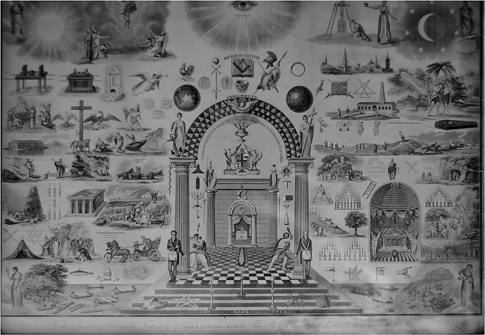
Thursday, November 01, 2007

A Masonic Code of Life


A MASONIC CODE OF LIFE
Salutem Punctis Trianguli!

1) In the morning, before rising, thank the God of your Heart for the new day that you are privileged to live on the earthly plane, and ask God to inspire you throughout the day. Then, standing facing east, take seven deep breaths as you focus on the vitality that is awakening in you. Afterwards, drink a glass of water and then begin your daily activities.


2) Despite the trials and tribulations of life, always consider life the most precious gift the Cosmic ever granted human beings, because it is the medium of our spiritual evolution and the source of the happiness we seek. Furthermore, regard your body as the temple of your soul, and take great care of it.


3) If you can, reserve a place in your home dedicated to prayer, meditation, and the study of the Masonic teachings. Make it your own oratory, your sanctum, and keep it free from any profane concern or activity.


4) Before every meal, give thanks to your God for being fortunate enough to have something to eat, and think of all those who do not have the privilege of eating their fill. If you are alone or together with other members of the Order, place your hands above your food, palms down, and say mentally or aloud this symbolic invocation: May this food be purified and magnetized by the vibrations radiating from my hands so to provide for my body and soul’s need. May all those who are hungry be associated with this meal and be given a spiritual share of its benefits. So Mote It Be!


5) You know that the aim of all human beings is to perfect themselves; to become better persons. Therefore, constantly endeavor to awaken and express the virtues of the soul that animates you. In doing so, you will contribute to your evolution and serve the cause of humanity.


6) Isolate yourself for a moment every day, preferably in your Sanctum, and send thoughts of love, harmony, and health towards humanity as a whole, particularly towards all those who suffer physically or mentally. Also ask your God to assist them on all planes and to preserve them as much as possible from the ordeals of life.


7) Behave in such a way that all those who share your existence or live in contact with you regard you as an example and feel the desire to be like you. Guided by the voice of your conscience, may your ethics be as pure as possible and may your first preoccupation always be to think well, speak well, and act well.


8) Be tolerant and defend the right to be different. Never use the faculty of judgment to blame or condemn anyone, for you cannot read the hearts and souls of others. Look at them benevolently and leniently, and see what is best in them.


9) Be generous towards those who are in need or less favored than you. Arrange things every day so that you do at least one good deed for someone else. Whatever your good deed, do not boast, but thank God for enabling you to contribute to the well-being of others.


10) Be moderate in your behavior and avoid extremes in all things. Be temperate, and follow the middle way in all circumstances.


11) If you hold a position of power, do not be overly proud about it and do not become intoxicated by the power you may wield. Never use your position to force others to do anything that they disapprove of or that is unfair, illegal, or immoral. Hold your office with humility and make it serve the common good.


12) Be attuned to others and speak with care. If you ever criticize, make sure that it is done constructively. If someone asks you for advice on a subject you do not know well, humbly admit your ignorance. Never stoop to telling lies, backbiting, or slander. If you hear malicious gossip about someone, do not support it by lending a willing ear.


13) Respect the laws of your country and endeavor to be a good citizen. Always remember, the key to human progress lies in the evolution of consciousnesses.


14) Be humanistic. Regard all humanity as your family. Beyond race, culture, and belief, all human beings are brothers and sisters. Consequently, they all deserve the same respect and consideration.


15) Consider Nature as being the most beautiful sanctuary and expression of Divine Perfection on earth. Respect life in all its forms, and look upon animals as conscious and sensitive beings—and not as mere living things.


16) Be and remain a free thinker. Think for yourself and not according to what other people think. Likewise, let everyone think freely; do not impose your ideas on others and always remember that your ideas are also evolving.


17) Respect all religious or philosophical beliefs, as long as they do not strike a blow at human dignity. Do not support fanaticism or fundamentalism, in any shape or form. As you live your faith, make sure that you are neither dogmatic nor sectarian.

18) Be faithful to your promises and commitments. When you give your word of honor, consider it to be a sacred pledge that binds you. If you must take an oath, think of the Square and Compasses, the symbol of your ethical ideal, while doing so, and remember that any lie you might tell will have karmic consequences for you. Although it is possible to deceive others, no one can escape Divine Justice.


19) If you can afford and wish to do so, support the Order materially, so as to promote its activities and contribute to its continuity.


20) The purpose of the Order is to contribute to the raising of consciousnesses, and the transmission of its centuries-old teachings. Therefore, make yourself available to present its ideals and philosophy to those who seek Knowledge, but without ever trying to coerce them.


21) Never cause anyone to believe that members of the Order are sages who are in full possession of the Truth. To those who may ask, present yourself as a philosophical person who is seeking Wisdom. Never pretend you are a Master Mason, but say you are a perfecting Freemason.


22) In the evening before going to sleep, summarize the day that is ending, and see in what ways it has been constructive or otherwise. In your soul and mind, weigh up what you have thought, said, and done throughout the day. From this draw useful lessons for your spiritual evolution and make firm resolutions. When this is done, send positive thoughts to the whole of humanity and entrust your soul to your God before going to sleep.

So Mote It Be!

Tuesday, September 11, 2007

THE COMPASSES AND SQUARE


THE COMPASSES AND SQUARE~

What is there in these implements that entitle them to be regarded with reverence as two of the three Great Lights of the Lodge? What do they really mean? And what is the meaning of the different relative positions of the points of the compasses and the square in the three Degrees? Are these meanings in any way connected with the saying that “the principal tenets of Freemasonry are included between the two points of the compasses?”
The earnest inquirer after truth, the student of Masonic symbolism, does not want ingenious explanations, worked out by the intellect of anyone. What he wants to know is whether these two symbols had any definite and fixed meaning when they became part of the inheritance of Freemasonry; and if they had what their real meanings were. He wants certainty, and not guessing, conjectures or speculations.
I inquired, some years since, of an eminent English Masonic scholar and antiquarian, Bro :. William James Hughan, whether the compasses and square were used on the altar in the same positions, in England, as among us, and since what time had they been so used; desiring to be sure that their use was not a novelty introduced in this Country.
He replied, “I cannot say how long it has been the custom as to the points of the square and compasses in the 1st, 2nd and 3rd Degrees. I am inclined to consider it an old one, as it is general”.
In a Lodge of the French Rite, when the Senior Warden is asked, “Are you a Master Mason?” his answer is, “I am; I have passed from the square to the compasses’.
The square is an instrument that can he applied to level surfaces and rectilinear angles only. The earth anciently was supposed to be a level, with occasional inequalities of hills and valleys. For many practical purposes it is regarded as level now. In the ordinary operations of surveying it is so treated, its spherical shape not being regarded. The surveys of the public lands of the United States are so made; and consequently the lines of adjoining surveys never coincide.
The compasses are used to describe circles, and in spherical trigonometry in which the square cannot be used. They are therefore a fit symbol of the sky, the heavens, which form as it were, the roof of a ha1f~sphere, in crossing which the heavenly bodies appear to describe arcs of circles; and the square is a fit symbol of the Earth.
In the copy of an engraving which is upon the first page of this essay these two symbols appear. It is taken from a Hermetic work in Latin by Basilius Valentinus, published in 1613. In it you see a naked human body with two heads, one male and the other female, one with the right and the other with the left arm extended. Over the male head is the astronomical sign that denotes the sun, and over the female that which denotes the moon, and between and above these signs is that which denotes the planet Mercury. In the hand which is on the male side is a pair of compasses; and in the hand on the female side is the square. These symbols, as you see, were engraved and published over
a hundred years before what is called the “revival” of Masonry, in I717, and they had been in use and had a settled meaning for hundreds of years before Valentinus published them.
We know with absolute certainty what their signification was to the Hermetic philosophers who used them. It is not a matter of conjecture or speculation but of absolute certainty of knowledge. The figure with one body and two heads represented the generative or creative power of the Deity and the productive capacity of nature. The generative power had its abiding place in the sky. Light is the great generative agent. The productive power is in the flat earth.
Every human being is of a compound and double nature, animal and material in part; and in part intellectual and spiritual His body is said to have been formed of the dust of the earth: his soul, spirit, intellect are of another nature. One is earthly, the other heavenly, one material, the other spiritual.
The compasses, which are a fit symbol of the heavens, are also a fit symbol of all that is heavenly and spiritual; the square which is a fit symbol of the earth is also a fit symbol of all that is earthly and material, in nature and man.
In every human being that lives, there are four forces, each always acting, and two of them apparently antagonistic to the other two. Two of these belong to the animal, earthly, material nature of man, the animal or sensual appetites and the passions. Both of these, man has in common with the animals; and so far as these rule him, he is but an animal. The other two belong to his intellectual and spiritual nature. One of them is the Moral Sense, whose conclusions are as absolute and infallible as those of the mathematics; by means of which Moral Sense, given in a greater or less degree to every man, he knows what is right and what is wrong for him to do. How little so ever of any moral code may control the conduct of an Indian wholly uncivilized, his Moral Sense teaches him something, at least this, that if a thing is placed in his hands to deliver to another, and he promises to deliver it, it is not right but wrong to fail to deliver it and appropriate it to his own use.
The other is the Reason, which reaches man what is the wisest and best for him to do for his own good, and this also belongs in a greater or less degree to every man.
These do not result from the combination of the atoms of matter in our bodies, It is a sufficient argument with which to refute those who think they believe that there is no God, that it is simply impossible, that the Moral Sense could originate in or be produced by any combination of material atoms, or by the action and counter action of any conceivable forces of matter. To create a moral law or a single tenet of it, there must be a superior Will to enact it; and that Will must enact it in obedience to the unerring conclusions of an infinite wisdom.
It is the Reason, by the analogies perceived and formulated whereby we attain by observation of phenomena, a knowledge of causes; and so have precisely the same kind of knowledge of the Infinite Will, Wisdom, Power and Beneficence, which reveals Itself to us in nature and in ourselves, as we have of electricity; of which in its essence we know nothing; but from its effects we attain such knowledge as is attainable by us, of what is.
The Moral Sense and the Reason come to us, as it was anciently said, “from above”; the sensual appetites and animal passions, anger, revenge, hate, jealousy, envy and the like, “from below". But they are not, as was once believed, implanted in us by the devil. They also are gifts and endowments which we receive from the Infinite Wisdom. For to them, are in a great measure, owing the heroism and endurance of human nature. They are the springs of human action and of human exertion, and without them no man could be great. It is by the potent action and counteraction of these opposite forces, the appetites and passions always acting in striving to overcome, but controlled by an undue subordination to the other forces, that true greatness is achieved. They are not evil and devilish, to be extirpated and mortified; for most of the great deeds which men have done in the world have owed their doing to these springs of action. Harmony everywhere consists in equilibrium, and equilibrium is the result of the alternating preponderance of opposing forces. The astronomers have been forced to suppose a centripetal and a centrifugal force, each the opposite and antagonist of the other, one drawing the planet towards the sun, and the other causing it to strive to dart away from it, the line of action of both be in one straight line in opposite directions, to explain the movement of the planet round the sun in its elliptical orbit.
When the candidate is prepared to be initiated, he represents man in the state of barbarism, ignorance and subjugation. He is neither naked nor clothed, barefoot nor shod; meaning that his faculties are but half developed, and that the Moral Sense and reason, though they exist in him are in a dormant condition, He is hoodwinked, and so deprived of light, symbol of his supposed deprivation of the light of knowledge and the obscuration of his intellect; and he is further symbolically deprived of the light of reason and knowledge of himself, of nature and of God, by being deprived of all articles made of the precious metals, gold and silver.
For gold was among all the old nations, the metal of the sun, and silver that of the moon. The same words meant ‘gold and ‘sunlight” because the sun in rising flooded the east with gold; and the same words in more than One language meant “silver’ and the moon’ The light of the sun symbolized the direct light of revelation coming from The Deity into the soul and enlightening it. The light of the moon, which is the reflected light of the sun, symbolized the shining into one soul of the light from another, the light of revelation reflected from one intellect into another and illuminating and enlightening it.
And his preparation was completed in the cable-tow around his neck.
We may compare him in this condition to, and consider him, representation of the vast masses of the common people of the ancient ages, say of the Egyptian toilers, a huge hoard of slaves, under the pharaohs, with no knowledge of nature or the causes of things, except what they gained through the senses, with not even a glimmering idea of one God or a divine providence, of a hereafter, or of anything for themselves after the end of their poor miserable life; denied knowledge by the priests, because the possession of it by them would make them dangerous; worshiping the sacred bull, the ibis, the scarabaeus, idols grotesque and hideous; slaves of’ their kings, to whom their lies were no more than the lives of insects; their reason dormant, their Moral Sense inactive; and in their appetites and passions, mere animals.
We may regard him as of a somewhat higher nature, a Saxon like Gurth born-thrall of Cedric the Saxon, or one of the peasantry of France in the days of Henry the Fourth; for he represents every man and every people in which the sensual appetites and animal passions have ruled with a dominion uncontrolled by the Moral Sense and the Reason.
When he is brought to light his attention is directed to the compasses and the square on the altar, and he is made to note that both points of the compasses are under the square. He is about to begin his journey from the west to the east in search of light, which is to "make progress in Masonry,” and he is to labor three years as an Apprentice before he can become a Fellow of the Craft.
The two points of the compasses symbolize his Moral Sense and Reason, and the two arms 0f the square, essential appetites and animal passions: and the two points of the compasses are under the square because in him as a candidate for initiation and deprived of light, the Moral Sense and Reason are supposed to be overpowered and subjugated by his appetites and passions, which belong to his animal nature. He is now to begin to “make progress in Masonry.”
When he becomes a Fellowcraft, he sees one point of the compasses above the square and one below it: which is to teach him that he is supposed, by zealous endeavors to attain the Lights to have attained at that moral and intellectual condition, in which his appetites and passions no longer have the entire habitual mastery over his Moral Sense and Reason, but these have become so strengthened and developed by his labors as an Apprentice as to be enabled sometimes and in some degree to hold their ground against the former and even overcome and control them.
And when he becomes a Master Mason, he sees both points of the compasses above the square; which is to teach him that he is supposed to have attained that condition in which the moral, intellectual and spiritual forces of his nature have become superior to its material and animal forces and energies, his Moral Sense and Reason have the habitual mastery over his appetites and passions, the divine in him transcends the human, and there is in him that equilibrium of the forces of his nature which constitutes excellence and entitles him to honor.
The habitual mastery-not never-failing, never-interrupted mastery, of his appetites and passions; for that is the condition to which no man attains or can attain in this life.
He is at last a “Master Mason,” because, and only because, he has become Master of himself. If he is not so, he deceives his fellows; for by permitting himself to be supposed such, and by having accepted the compasses and square, lying upon the holy hook of his faith on the holy alter, illuminated by the three lights that symbolize the Deity —the compasses and the square which are the symbols of God the Creator, and of nature, of which God is the soul and whose forces are His varied actions- as a true symbol of his moral and intellectual condition, he in the most solemn manner pledges his faith and soul and honor to all his Brethren and the whole Order, that he is and will continue to be in all things such as he so represents himself.
And if, ever afterwards, when present in the Master’s Lodge, he feels and knows that the compasses and square, as they lie there, are not a true symbol of himself, but false, because these are not so, he is a living lie, and should turn his back upon the symbol and upon his Brethren and go mournfully away.
Thus the question, by what right are the compasses and square made two of the Great Lights of the Lodge, fit be counted as such with the Holy Book of one's faith, is, it seems to me, satisfactorily answered; and I know no other way in which it can be.
And we may now, perhaps, learn what is the meaning of the phrase, that, “the principal tenets of Masonry are included between the two points of the compasses.” You may perhaps see it now: but I think if I had at the beginning, asked you who read this to stop and reflect upon the phrase, and see if it had any meaning to you, you would, after repeating it to yourself again and again, have been compelled to admit that it is one of those phrases which sound well and seem to mean something, but which when examined, are found to consists only of so many words arranged in a sentence which has no meaning at all.
But "the principal tenets of Masonry” are the whole moral law, and that moral law wholly consists of the dictates of the Moral Sense and the conclusions of Reason; and as these are symbolized by the compasses, it follows that the principals of that law or the tenets of Freemasonry, are included between the two points of the compasses.
You may now also understand why a Master Mason has “passed from the square to the compasses” and from the high place of Gibeon, where the ark of the covenant rested, to the threshing-floor of Ornan the Jebusite, the site of the temple in which it was finally deposited.
The three lesser lights, it is said, are the sun, the moon and the Master of the Lodge. How long is the Lodge, how broad, how high and how deep? The Universe is the Lodge by Masonry’s own definition.
The sun and moon, to the ancient Egyptians, represented Osiris and Isis; one said to be the Deity and the other nature. But we get little knowledge as to what the Egyptian Deities really meant, from the monumental inscriptions cut in stone by command of the old monarchs of Egypt. I believe that Osiris was the Deity as Will and Power, and Isis, the Divine Wisdom in the Deity. Thoth was the Divine Word, the utterance in Humanity of the Divine Wisdom. The Greeks called him Hermes, and represented him as the giver of all knowledge to men. He was the Logos; of whom St. John afterwards said that He was in the beginning with God and was God.
In the old Hermetic engraving copied at the beginning of this lesson, the sign of the planet Mercury is above those of the sun and moon, midway between them; and the Greeks called this planet also Hermes. He is the nearest to the sun of all the planets; and consequently is seldom seen; for if he rises before the sun, his rise is so little a while before the sun’s; and if he sets after the sun, his setting is so little a while after that of the sun, that he is almost always in the golden glow of light of sunrise or sunset so that one’s eyes cannot discern him, I, being nearsighted, have never seen him, when another who was with me has; and Copernicus, the great Danish astronomer it is said, died lamenting that he had never seen him in all his life.
To the Egyptian Hermes, Thoth, is ascribed the promulgation of the philosophy distinguished by his name as the Hermetic: and various writings in Greek, by unknown authors, have been ascribed to him, some of which are still extant. Into the possession of the Hermetic philosophy came the symbols used by Pythagoras with his secret explanations of them, and his doctrines in regard to numbers; the knowledge of all which was always confined to a few adepts, and so became almost universally misunderstood. In the Sixteenth, Seventeenth and Eighteenth Centuries, Hermeticism became connected with Alchemy; and by what seemed mere jargon and an unmeaning babble of words, the meanings of its symbols and their true explanations were carefully concealed from the multitudes, and as carefully from the Priesthood, who would have pronounced the doctrines heretical and burned at the stake those who taught them.
We find in Freemasonry the principal symbols of the religious doctrines of the Zend Avesta, the book of the faith of the ancestors of Medians and Persians, and of their priests, styled the magi, "The wise men of the east,” who possessed the doctrines when Cyrus, of Median descent, became Master of the great city of Babylon. These doctrines Pythagoras learned; and as he could not have learned them elsewhere, the presumption is that the tradition is a true one, that he visited Babylon and was a pupil of the magi, as he had been of the Egyptian priests. He made these doctrines known to his disciples among the Greeks and invented symbols, especially the right-angled triangle and the lesser and the greater tetractys, to perpetuate the knowledge of them among the adepts and conceal it from all the rest of the world; in which he was so successful that, as Plutarch, ascribing the use of the right-angled triangle to the Egyptians, interpreted it in a manner altogether incorrect, so Yamblichus, writing of the life of Pythagoras, showed a profound ignorance of the meaning of his symbols; and the meaning of what the great philosopher said as to the virtues of numbers unconnected with things, as totally unknown yet.
Hermes, the Egyptian Thoth, the Divine Word, bearing the same name as the planet Mercury, was "The Master" of the Hermetic philosophers, the ”Master” of the Universe, the Divine Presence in it, the Master of Light and Life, and the mode of concealment of things in Masonry is strikingly shown by questions and answers, “Have you seen your Master today,” etc., given above. For Hermes, the planet, while in the blue ground of the sky is also always in the golden glory of the sun; and by these questions it was ascertained whether the person to whom they were put was a Mason, acquainted with the secret doctrines of the Hermetic philosophy.
By this and many other proofs we know that the symbols of Freemasonry were introduced into it by the Hermetic philosophers in England, one of whom at least was a Mason-E1jas Ashmole.
The “Master of the Lodge” was Hermes, the Divine Word: and the phrase, “The sun, the moon and the Master of the Lodge:’ finds its exact symbols and representation in the Hermetic engraving given at the beginning of this lesson.
The sun represents the Deity: the moon the Divine Wisdom and to these three the various triads of the Lodge allude.
Hermes said that the universe was the second god, and man the third, why and how, he did not clearly explain. The books bearing his name were given by those who did not intend to make known to the whole world the meanings of their symbols. It would have been better if Masonic writers of books had imitated, their caution and reticence; for with Mackey’s and Oliver’s works on one side and our Monitors on the other, any Profane may know all that the mass of Masons know about Masonry.
Fortunately these writers could not disclose what they did not know, and the real meanings of our symbols are still our own, notwithstanding our itching for notoriety so prevalent now in the Order, and the irrepressible desire of Masonic journalists and others to print and publish everything.
The universe is the idea of the Divine Wisdom, realized, as the making under the direction of the inventor, perhaps without his own hands touching it, of the machine of wood and metal, is but the expression in these of the model in the mind of the inventor. It is in the universe that we see all of the Divine Wisdom that it has disclosed or will in this life disclose to us. In it alone we attain unto any knowledge of that Wisdom. It is the Soul of the Universe; and therefore the universe, its body is said to be the second god.
In Man is the Divine Word, the Voice and utterance of the Divine Wisdom, Every human intellect has in it something of the Divine nature.
It is a ray from that in the Deity which is something higher than our Reason and Intelligence, but of which these are effects, as light is an effluence from the flame of the fire. These are the doctrines of Hermetic Philosophy.

Albert Pike

Tuesday, August 28, 2007

Ten Master Masons


Ten Master Masons

Ten Master Masons, happy, doing fine;
One listened to a rumor, then there were nine.

Nine Master Masons, faithful, never late;
One didn't like the "Master," then there were eight.

Eight Master Masons, on their way to heaven;
One joined too many clubs, then there were seven.

Seven Master Masons, life dealt some hard licks;
One grew discouraged, then there were six.

Six Master Masons, all very much alive;
One lost his interest, then there were five.

Five Master Masons, wishing there were more;
Got into a great dispute, then there were four.

Four Master Masons, busy as could be;
One didn't like the programs, then there were three.

Three Master Masons, was one of them you?
One grew tired of all the work, then there were two.

Two Master Masons with so much to be done;
One said "What's the use," then there was one.

One Master Mason, found a brother -- true!
Brought him to the Lodge, then there were two.

Two Master Masons didn't find work a bore;
Each brought another, then there were four.

Four Master Masons saved their Lodge's fate;
By showing others kindness, then there were eight.

Eight Master Masons, loving their Lodges bright sheen;
Talked so much about it, they soon counted sixteen.

Sixteen Master Masons, to their obligations true;
Were pleased when their number went to thirty-two.

So we can't put our troubles at the Lodge's door;
It's our fault for harming the Lodge we adore.

Don't fuss about the programs or the "Master" in the East;
Keep your obligation by serving even the very least.

Author Unknown

Thursday, August 02, 2007

Albert Pike's Address to the Brethren


My Brethren, there are many fields of Masonic labor, and every one must work in that wherein it seems to him that he can do the most good. But, whatever else we may be, we are all Master Masons, and we all owe to the Masonry of the Blue Degrees our first and paramount allegiance. No man is without offence, whom makes these Degrees mere stepping-stones by which to ascend to what he deems a higher level. If he does so, he is not worthy to wear the decorations of the Degrees to which he supposes himself to have ascended. These are higher than those of the Blue Lodge, in only the single sense, that they are built upon it, as the upper stories and attic of a house are built above the
Ground-floor, to which are in no sense superior to more honorable, unless they are intrinsically so by virtue of a higher instruction, a profounder philosophy taught by them, a purer morality inculcated, a truer and better illustration and explanation of the symbols. If really of a higher nature by virtue of these, they would be equally so, if the numeration of the Degrees began at the top, and that bearing the highest number were at the bottom..,.
If our labors and writings in other Degrees and Bodies tend to elevate the Symbolic Masonry, to illustrate its symbols and invest them with a higher significance and a more solemnly religious meaning, to apply and expound and comment upon and make more forcible the moral law of the Blue Degrees, ‘the principle tenets of Free-Masonry; ‘included between the two points of the compasses to communicate to the zealous Masonic student more exalted ideas of the God in whom Masons put their trust, and strengthen him with more convincing proofs of the existence of the soul after this life ends, then those who work and write there are the efficient Apostles of the Free-Masonry of the Blue Degrees, true fellow-workmen in the field of Masonic labor,,..
Let us, therefore, my dear Brethren, always remember, that first of all and above all, we are Master Masons; and wherever we work and labor, calling ourselves Masons, let us work and labor to elevate and dignify Blue Masonry; for we owe to it all that we are in the Order; and whatever we may be elsewhere, we are always amenable to its law and its tribunals, and always concerned to maintain and magnify its honor and glory.

Brother Albert Pike

Monday, July 16, 2007

Reincarnation Israel Regardie


Reincarnation

Israel Regardie

In consulting the works of the ancient Kabalists and Medieval Hermetic Philosophers, we find the phrase "The Microcosm of the Macrocosm" being applied continually to man. These spiritual scientists conceived man to be a smaller world, fashioned in miniature exactly along the lines of the greater world, the Universe, the Macrocosm. They further postulated that "That which is above is like unto that which is below." Consequently the laws that are seen and known to operate in the Universe, correspondingly must work in man. Therefore, in first considering this subject of Reincarnation, let us examine the world around us and endeavor to place it on the basis of one law, observed to prevail in Cosmos - the Great Law of Periodicity. Occult Philosophy lays down the postulate of the Eternity of the Universe in toto as a boundless plane, that is, as space, periodically the playground of numberless universes incessantly manifesting and disappearing. The Absolute Universality of this Law of cycles, of flux and reflux, of ebb and flow, which physical science has recorded in all department of nature, and alterations such as those of day and night, life and death, sleeping and waking, summer and winter, are facts so common, so perfectly Universal and without exception, that it is easy to comprehend that in then we see one of the absolutely fundamental laws of the Universe, for these two are the world's eternal ways.

Our earth in the spring discards its white blanket of snow and emerges forth from its period of rest - its winter sleep. All activities are exerted to bring forth new life everywhere. Time passes. The corn and vegetation are ripened and harvested, and again the busy summer fades gradually into the silence and inactivity of the winter; again the snowy coverlet enwraps the earth, but her sleep is not forever, for she will reawaken to the song of the new spring, which will mark for her a little further progress along the pathway of time. So with the life of man. Is it conceivable that this law, so perfectly universal, so cosmic in its scope should be inoperative in the life of Man? Shall the earth wake each year from its winter sleep; shall the tree and the flower live again; shall all these examples of this great law continue to be observed and man die? It is inconceivable and impossible. It cannot be. The same law that impels wakefulness in the plant, and stirs it to new growth will wake the human being to new experiences to the distant goal of perfection. Therefore under this same Universal and therefore Spiritual Law of Periodicity, operating on and through man, he faithfully follows the similar fluctuations of being, Birth, Youth, Maturity, Decadence, and Death, to enter Birth again, to be moulded to a better purpose, perhaps, than has been possible in the old one.

"If a man die, shall he live again? All the days of my appointed time, will I wait until my change comes." This appeal was uttered by the Prophet Job of the Old Dispensation, and his very cry "If a man dies, shall he live again" is indicative of the dissatisfaction of mankind, then, as well as now, with the biblical allotment of three score years and ten for the expression of consciousness. To all appearances, man flits like a firefly out of an eternal past, only to be extinguished for an eternal future, after a life of expression that in comparison, in these latter days of science, with even our materialistic concepts of space and time, is actually of shorter duration than the spark of an electrical discharge.

Nature requires millions of years to produce a grain of sand - when we review all the processes that have lead up to its present state as such. The California Redwoods are silent but eloquent symbols of nature's creative handiwork, enduring for centuries and in the estimation of some of our modern biologists for even thousands of years. And yet Man, the epitome of all the creative forces in Nature is assumed in the cold estimate of materialistic science to be merely the evolution of a speck of protoplasm, growing like an artificial laboratory culture until after reaching maturity, it is annihilated - to be seen no more for ever. In the lifetime of a single man, thousands of animals, fowl and fish, hundreds of thousands of vegetables have given their lives in the support of his existence. Thousands of animals have given their lives in the work of experimental scientists in their endeavors to improve man's physical condition. Multiply this in the case of one man by the countless myriads of individuals that have trod the surface of this earth since the dawn of the human races. What a prodigious waste of energy? What a crime against the lower kingdoms? - if 35 to 65 years is to be the average life of an individual and the only expression that he is to be permitted to have after the whole earth has given of its best to train and to equip him for constructive work. It is unthinkable to those who stop to think of it at all. There must be some compensatory condition, and since the beginning of the human kingdom, its thinking members have sought that compensation. It is found in Reincarnation.

From the Totem Pole our American Indians to the hideous effigies of Deity in Asia; from the Chinese Joss to the beautiful Altar in the Christian Cathedral, the same fact is in evidence, that from somewhere down through the remote and obscure ages, humanity has been invested with the truth - the truth that there is another life, and another opportunity beyond this present life, and those millions who have delved deepest into truth have found beyond doubt this truth of reincarnation.

Now, being forced to admit that reincarnation is a necessity in nature, and granting we admit of the existence, and immortality of the human soul, we find that this doctrine of pre-existence and rebirth is the only one yielding a logical and self satisfying explanation of the phenomena of life. This doctrine, which is an extremely simple doctrine, rooted in the assurance of the soul's indestructibility and immortality, implies a persisting and expanding intelligence, through all changes of embodiment, the latter being but a means towards the great aim and purpose of the Intelligent man within, the gaining of what the ancients called All-Knowledge. It teaches that the soul enters this life, not as a flesh creation, but after a long course of previous existences on this earth, in which it acquired its present inhering peculiarities, and that it is on the way to future transformations, now being shaped by the soul. It claims that infancy brings to this earth, not a blank scroll for the beginning of an earthly record - nor a mere cohesion of atomic forces into a brief personality that is destined by its own nature to dissolve again into the elements - but a definite immortal character that is its own, due to long experiences, acquired through self induced and self devised efforts throughout long series of incarnations.

What is the Universe for, and for what final purpose is Man, the Immortal Thinker here in evolution? Centuries ago, the Fraters Rosae Crucis stated that it is all for the experience and emancipation of the Spirit, for the growth of the soul, as well as for the purpose of raising the entire mass of manifested matter up to the stature, dignity, and position of conscious godhood. The aim for present man, and also the three kingdoms below him, in his evolution and initiation into complete knowledge, and in this Rosicrucian concept is evolution carried to its highest power, and to its logical conclusion. It makes of man a God, and gives to every part of nature the possibility of being the same one day; there is strength and nobility in it, for by this scheme, no man is so originally sinful that he can not rise above all sin and attain to the highest.

Men, in general, accept evolution as a proven law of growth, the evidence being drawn solely from observed changes in physical forms and species, but this general view considers only external evidence of the operation without any understanding of the inner and actuating cause. The word "Evolution" really means an unfolding from within outwards, and had not our scientists been so materially inclined they might long ago have arrived at a knowledge of the truth. The Rosicrucian doctrines make clear the operation of evolution and carry it to its highest point of logic by showing that the impelling force is Intelligence, which itself at the same time is evolving to greater and greater heights by means of temporary forms of expression. Thus we find that Rosicrucianism postulates a dual evolution, a physical line - that of the evolution of form - and a spiritual line, that of the evolution of Intelligence and Consciousness, and from this, we have to admit that this double line of evolution can only be carried on through reincarnation, for what happens to the spiritual element in Man after death. To dwell in a monotonous heaven - as postulated by Theology - is illogical, therefore after a period of rest, in accordance with that law of Periodicity or Rhythm - previously mentioned - the Spirit returns to earth to resume its further progress.

The object of life, then, is the gaining of all knowledge, and the acquirement of experience, the scale of which we find to be enormous. Knowledge infinite in scope and diversity lies before us, and we have much more than a mere suspicion that the extent of the field of truth is vastly greater than the narrow circle in which we are confined. We also perceive that we have high aspirations with little or no time to reach up to their measure while the great troop of passions, desires and selfish motives war with us and even among themselves. All these have to be conquered, and subdued, and as we know that one life expression is insufficient to do this, and to acquire all that we know we must acquire, we must conclude then that a series of lives has led to our present condition, and that the process of coming here again and again must go on for the purpose of affording us the opportunities needed.

Through some process of reasoning, some persons have arrived at the conclusion that reincarnation is injust because we suffer for the wrong deeds performed by another in some previous incarnation. But this is based on the incorrect notion that the person in the other life was someone else, but in every life, it is the same person. When we return to earth life, we do not take up the body of someone else, nor another's deeds, but are like an actor who plays many parts, the same actor inside, though all the costumes and lines differ in each play. Shakespeare was correct in asserting that Life is a Play, for the great life of each Ego is an Immense Drama in the Scheme of Things, and Nature is the great stage on which this drama is played, and thus each new life and each new rebirth is but another act in which we assume our part and put on another dress, but through it all, we are still the self same, Immortal Ego.

While this doctrine - coupled with its twin - Karma - may seem stern and implacable to some, they are not really so, for they are essentially optimistic, and give us a great deal of encouragement. Reincarnation gives man an opportunity to try, try again with the assurance that each sincere and earnest attempt brings its reward in time. So those who sit despairing in the dark places may take courage. Those who are perplexed and filled with doubt may know that there is a solution to all their troubles and difficulties. The mother bereft of her child; the husband or wife left desolately alone, may find consolation for they will meet again to take up the broken threats of affection and weave them into new and fairer looms of progress. Thus the heart finds complete satisfaction and the intellect more than its fullest scope in these teachings of the Ancient Fraters of the Rosae Rubeae et Aureae Crucis.

Monday, June 11, 2007

CLIPSAS, 45 YEARS (Interesting Read)


GLADA – Grand Lodge Architects of Aquarius

Sao Paulo – Brazil


CLIPSAS, 45 YEARS.


The foundation of The United Grand of England can be considered the most important Masonic event of the 18th century, gathering lodges under a central administration, standardizing Rites, proceedings, rules and so on. The union of lodges around a central administration was succeeded after some time by the union of small kingdoms, duchies and European princedoms, giving us the countries we know today. We can recognize a trend of our time in getting together because of ideals, needs, common politics, activities, business and powers. All of that contributed to the coming of Globalization and helped forming the big political and economical powers of today.

However, also with the uniformization of philosophical principles, the foundation of the UGLOE, brought the preconceptions, prejudice and dogmatism of that time and place of birth. Landmarks, which were odd to the Old and Universal Masonic Customs, were inserted in the Anderson Compilation.

It is natural that Masonry embodies external characteristics of its time, but that does not mean it has to embody any local dogma or prejudice, once the purpose of this sublime Institution is to struggle against the dogmas.

Besides, the UGLOE established some “regularity” criteria that can be considered unacceptable, arrogating powers that we do not know today. These “regularity” criteria do not reveal any concern with the purity of the Masonic principles, actually they reveal remains of Colonialism.

Therefore, the foundation of CLIPSAS was an authentic historical need, and sealed a new moment in the evolution of Masonry. This one can be considered the most important Masonic Event of the 20th Century. Since then the undogmatical and laic content of the Order, has been restored. These sublime principles are timeless and are beyond local and personal beliefs.

We are imprinting a new way of fraternal companionship these days, adapting ourselves to the modern habits, communicating via satellite, and embracing ourselves through Internet. We simplified our Rites, compared to the old customs, but more importantly, we kept the essence of them.

CLIPSAS has achieved its mission in the past 45 years, uniting Masonry around Laicism and Free Thinking, so that we are following a stream of our time, when Religion and The State have to be separated.

Great results have been obtained; bringing us the EU (European Union) and the European Parliament, besides the new economical groups that helped restore the political balance of the world, threatened by the weakening of the Ex Soviet Union. These are conquests to be ascribed to Masons in general and to the CLIPSAS operations, specially ascribed to the main European Masonic Obediences --- liberal, laic and undogmatical --- that are leading such movement.

Nowadays, people and countries endangered of having their rights violated can fall back upon the European Parliament, a kind of jurisdiction certainly more active than any other UN jurisdiction. These are important steps towards Democracy, World Peace and Justice. As we see it, CLIPSAS role has not been concluded yet. It is not about gathering and welcoming Obediences by considering them rightful and consistent with Laicism anymore. It is necessary to go further, preparing proposals to the governments, to the International Organizations, Non-Governmental Organizations, to all kinds of Institutions, suggesting some useful planning to keep peace, generate prosperity, reduce poverty and political arrests, reestablish diplomatic relations, improve educational systems, extinguish social and economical problems, and help in the decision making of effective environmental protection.

It is fundamental to show we Masons are taking part in the development of the world. If it is necessary to protest so let’s do it, if it is necessary to change the system so let’s do it, if it is necessary to free minds, and to support Non-Governmental Organizations so be it. We have to be effective and make Humanity awakes to the Love of Truth and to pursuit this Truth wherever it is. We have to show Humanity that Power, Profit and Privilege are not the only way.

In the course of History, there were always great Mason thinkers who idealized and inspired the key-ideas that promoted the big changes. There is a Torch in History, like the one Athletes carry in the Olympic Games throughout the countries, towards a Great Event that gathers the ones who are more capable and the best in each modality. A torch that is being taken by the free thinkers, taking to people, generation after generation, teachings of all kinds obtained by the previous civilizations, telling about the good and painful experiences they went through, sharing with us the wisdom they reached through their mistakes and lucky hits.

We propose that our great free thinkers of CLIPSAS, today in enough number to make a difference, start to put into practice in their countries and communities more effectively than ever our Masonic ideals, no only as a moral teaching or as a way of thinking, but as constant and important activities and as a duty in a daily basis.

We can feel the urgency of this action by giving a look at the shocking state some regions of our Planet are. It is like a cry for help to whom we cannot say No, once the constituted powers do not seem to be caring or simply do not want to get involved and promote the necessary changes.

Masonry should express itself in a keener way, through the media or through any open channel that society provides us. We must claim for justice, for transparency, for more integrity of the ones who rule people, more energy to fight corruption, crime and misery. We should stand against the addictions and the political interests that harm people and jeopardizes the balance of the world.

All the knowledge brings us a moral duty; Initiation imposes us a commitment before Humanity. Not fulfilling it is to feel guilty before the most important and elemental commitment accepted by us at the very day we became Masons.

Let’s remember and evoke all the Masons that came before us and who died for Humanity. Let’s be worthy of their inheritance. Let’s honor them. Dreaming and idealizing is not enough. We have to put our thoughts into action, everywhere and every time to be part of a better world for real.


Vera Facciollo – Grand Master

Tuesday, May 29, 2007

ADDRESS TO THE 2002 CALIFORNIA MASONIC SYMPOSIUM

By Alain Bauer, Grand Master of the Grand Orient of France
Sacramento, California, July 27th, 2002:


"We respect your independence because we were a part of it and because you were, twice in our history, the forceful weapon and working tool of our own freedom. Allies forever, do we really care about the English Masonic bureaucracy? It may be time for a Masonic Tea Party"


It is a great honor to be your guest at this 2002 California Masonic Symposium. I want, first of all, to thank the Most Worshipful C. Ray Whitaker, Grand Master of Masons in California, for his very fraternal invitation.
In prior communications the leadership of the Grand Lodge of California asked me to speak about "The Great Divide: The Grand Orient of France and Dogmatic Freemasonry." Let me say here to you that this was a very great... surprise! After all, we do not think that such freemasonry exists. James Anderson was very clear about this at the beginning. We respect and welcome in the Lodges of the Grand Orient of France those who believe or do not believe. Neither Atheist, nor extremist, there is nothing in the Grand Orient that gives us as Masons the right to determine a definitive approach to advancement, or a specific stream, that leads to our individual accomplishments and personal growth through the Craft.
First, I want to acknowledge that critical parts of my speech have been prepared in collaboration with my very close friend and brother, Grand Commander of the Ancient Accepted Scottish Rite of France, Alain de Keghel.
The time now has come to engage fraternally in a deep and sustained analysis of the Masonic landscape, as it is, not as we imagine it to be. All Brethren of good will are now looking toward a more open-minded, more tolerant, and more Masonic approach to our Brotherhood.
To that end, increasing numbers of Masons from around the world are making the necessary efforts to build a bridge of Light which does not end at national borders or within the limits of individual Masonic bodies. It is time to open eyes, minds, and hearts, to the inherited legacies of our diverse and rich traditions.
It is indeed a great privilege to have the opportunity to open more widely the doors of understanding. So let us attempt in our time together to overcome the friction of difference that far too often marks the realities of the profane world, and tarnishes our Masonic world.
The Masonic Order has endured through the vicissitudes of time, culture, civilizations and society. However, it has survived through the centuries not by following passively the movements of society, but rather it often has been at the forefront of important change within society. In those moments of leadership it has been at its strongest.
As one important illustration, simply being here in the United States of America, brings to mind the major role American Masons, and some of their French Brethren, played in establishing modern democratic society.
We can all give our deepest thanks to George Washington, Benjamin Franklin (Who I can tell you with great pride was the Worshipful Master of a Grand Orient of France Lodge in Paris.), to the Marquis de Lafayette, and to many others who worked so strenuously for freedom that time will not permit us to list all of their names today.
In point of fact, there have been important and fruitful moments of deep contact between French and American Masons going back even before the time of the American Revolution. Nevertheless, we know from history and personal experience, that there are different traditions in America and France. Because French Masons realize fairly well how difficult it is for some of our Brethren on this side of the Atlantic to understand how it came to pass in France that there is such a great variety of Masonic bodies and Masonic streams, or traditions, it would be of value to discuss France to some degree.
With your permission, let us consider together some historical facts but also some issues that may be regarded as premature in the emerging transatlantic dialogue, or even hazardous. In order to do this to full mutual benefit, it is obvious that we first need to know each other much better than we do.
To be direct and to the point, I will first offer a few words concerning the Grand Orient of France: It has not relinquished the dedication to The Great Architect of the Universe and it has never initiated women. It is the oldest traditional Masonic body in France. This fact was just confirmed a few weeks ago by the United Grand Lodge of England to the Minnesota Grand Lodge here in America. And as I briefly mentioned earlier, the fact that there was a very strong commitment by the Grand Orient of France to the establishment of Freemasonry in the early years of the United States of America is well documented.
The Grand Orient of France is a federation of Lodges using different workings where every single Lodge has the freedom to choose a Ritual belonging either to the French Rite (a legacy of the old English Rite), the Ancient Accepted Scottish Rite, the Rectified Scottish Rite, as well as the Royal Arch, Mark Masonry, Memphis-Misraim, and the Emulation Working. Our lodges, which are free to choose their working are also free to work to the G.A.O.T.U.
The Grand Orient with more than 44,000 Brethren is the largest French Masonic organization in a country which counts a total of roughly 130,000 members working in a Lodge. This is a number which may sound ridiculous by comparison with some 2 million Freemasons in America, but you must consider the size of the French nation which totals sixty-million people (compared to 288 million Americans).
Of course this number is approaching less than a half of the amount of Freemasons in the United Kingdom. However, like the USA (of course, we do not ignore the dark times of the Morgan affair in your country), Great Britain is the only country in Europe where Freemasons were never persecuted and where our Masonic Order had a chance to develop without the negative interference of the churches, and politics. This situation, by the way, is changing in the U.K. with a Catholic Prime Minister strongly challenging the role of Freemasonry in British society.
This history explains why continental Europe does not total today much more than some 250,000 Freemasons. Out of this number, nearly half are French. To be more complete in this presentation, it should be added that France has benefited from an additional important feminine Masonic and mixed-gender Masonry development since the early 20th Century.
It can be noted with interest that the first recorded Masonic Lodge was created in France in 1688. The first Masonic Order in 1728 was named "Grande Loge" before changing its name into the "Grand Orient de France" in 1771-1773. That same year a new "Grande Loge de France" was created by dissident members, who then in 1799 joined yet once again the "Grand Orient de France." Finally, a new "Grande Loge de France," our friend and sister obedience, was created in 1894. The Grande Lodge de France still exists today with more than 20,000 members and is an outgrowth of the same Masonic roots.
In overall percentages, French Lodges can be broken down into the following numbers: 69% male, 20% belong to mixed-gender masonry and 11% are for women only. One may consider also that 75% of French Masons are men, but that over the last 30 years, the relative percentage of women has more than doubled rising from 10% to nearly 25%.
As many of you will know, a great turmoil began in 1877 as the Delegates of the Lodges of the Grand Orient of France while attending the annual General Assembly, and after fierce debate, made a decision and voted to lift the mandatory obligation to refer to T.G.A.O.T.U. in Lodge rituals. It is interesting to note that the motion to introduce this dramatic change was introduced by a Protestant Minister and Brother, Frederic Desmons. One must today realize that this happened in the context of French post-revolutionary society which had fought successfully for a separation of the State from the Catholic Church. I can bear witness today to the liberty given earlier by the French Lodges for those non Roman Catholics that were persecuted in subsequent years and decades after the Revocation of the Edict of Nantes in 1685.Lodges of the Grand Orient were the places of refuge of free thought and liberty against the great darkness of this period.
In earlier times under the Kingdom there was no desire to accept any level of ecumenism by established religion. There simply was no tolerance of different beliefs in established religion. After the French Revolution of 1789, the Catholic Church as an institution which tried desperately to regain the temporal power it had lost. It was in this context that the signature of the Concordat of 1801 had as its first consequence for French Freemasons their effective excommunication. This occurred as a result of the Encyclical "In Eminenti Apostolatus Speculae." The immediate effect of this was to produce a radicalization of the relationships between the conservative Catholic Church and the Grand Orient. Remember that the Grand Orient was at this time deist in its majority but still supportive of the gains of the Revolution: Freedom of speech, freedom of conscience, freedom of religion, were, and still are, our motto. We also wanted to become free from English Masonic colonization. Does this not ring a bell?
The Masons in 1877 believed their decision expressed in a democratic vote was a way to return to the original and very liberal spirit of the Constitution of James Anderson. That was the heart of the matter. That is what was in their thinking. The focus was on Anderson's Constitution as it had been written in 1723, before the changes made in 1738. In fact, Masons before 1717 were officially "Catholics," they became "Christians" and then "Noachites." The Grand Orient of France merely climbed an additional step, asking them to refer to the "Universal Moral Law," as specified by the 1723 Constitutions.
This would mean, as well, a focus on Anderson's Constitution well before the extensive changes undertaken in 1813, and before the 1929 modifications with the so-called "eight fundamental obligations." These are the later obligations necessary in order to attain recognition from the United Grand Lodge of England.
It is not the purpose here to place too much emphasis on this most sensitive and controversial issue, which all too easily pollute Masonic relations and discussion. Unfortunately, there is not much substantive reasoning at all on the topic today.For example, there is very little examination of the historical facts as a necessary background to the discussion.
The matter has sadly poisoned the relations between different Masonic streams. It has produced a Masonic reaction which many Masons around the world still do not understand: a kind of Masonic equivalent to the Pope has emerged with established rules of excommunication and a kind of "new grand Inquisitor."
In France, most Brethren simply did not care about this break in the Masonic family. They regarded this evolution in the breakdown of relations with regret and sadness, nevertheless, they lived their lives as Free Masons and they went their own way. This is how it was in the past, and it is still so today.
However, in the course of affairs, one Masonic body did decide in 1913 to work the "regular" way. This was the origin of the Grand Loge Nationale Française (GLNF), which today claims more than 20,000 members.
You must realize that despite differences this Grand Lodge often shares the same Temples with other Masons outside of Paris. This occurs even though Brethren belonging to other streams do not work together with the GLNF in closed tiled Lodges. Nevertheless, substantive relations do exist. In very recent times, the respective Grand Masters of GLNF and GODF have worked to establish a new kind of relationship and signed agreements on the recognized quality of the initiation process, on disciplinary issues and on diplomatic relations.
We meet regularly, we accept transfers from one Body to another, we respect our mutual differences. This offers some hope for a brighter Masonic future, at least in France.
One has to realize that Freemasonry developed in a different way in France as well as in several other continental European, Latin American and African countries. It is something we have to deal with. It is an issue we would be wise to address and not ignore. There is no need to lock ourselves into unnecessary compartments and singular ways of thinking. We need to be concerned about the weakness that results from unnecessary divisions. We would be much wiser to prefer a universal perspective.
After all, our way of thinking is in part a legacy of the great philosophers and writers of the time of the Enlightenment: Voltaire, Rousseau, Montesquieu, Diderot, and so many others.
Part of the task at the moment is to now pass on the rich heritage of our humanist and Enlightenment values to future generations. In the cause of freedom, and more, this tradition was fought and died for in France and America in the Eighteenth-Century. This must not be lost.
The essential point is that our Masonic message is still of considerable value. The great, generous and original ideal of Freemasonry to "unite people who otherwise would have remained at perpetual distance" is also a modern and vital message to our contemporary society endangered by egoism, ethnocentrism and crude materialism. At this time, everyone is speaking of globalization. But where are we as Freemasons in the contemporary world? Are we not at risk in our current situation? Is it not possible that the world will pass us by in the new millennium if we do not actively engage with humanity once again and give the message that is expected from us?
Of course, in your great country, in the U.S.A, you have been fortunate in having a series of prestigious heads of state as members of our Brotherhood. But even here does this not belong to the past?
Do we not have to stop and ask ourselves why the winding down is developing in this fashion? What can we do to return to a greater effectiveness, relevance, and visibility in our respective societies? Social meetings and charities are good, but they cannot be our main and only goal. In a modern society where every person is solicited for something, we have to become more attractive to those people having something to contribute to society. We all agree that Lodges do not have to interfere in politics. But does it mean that we, as Brethren, as individuals, need to stay silent as mere spectators in the profane world?
Always working in reference to our ethical values as Masons, we should be more sensitive to the important issues confronting modern society: education, discrimination, the preservation of individual rights in a computerized society, rules of ethics in biotechnology, the proper and careful management of genetic modified organisms and of modern medicine, problems of environment, as well as of aging people, youth violence, challenges like drugs, tobacco and alcohol abuses. Young people will expect this from each one of us before they join our Lodges. They will not join if we neglect the vital issues of our respective nations, or of the world as a whole.
If Freemasons do not engage the world in front of them, they will, without doubt, lose the best and brightest of our youth. Fraternal relations as you and I have practiced them are not enough. The youth of our respective societies have many opportunities for socializing elsewhere more in keeping with the social and cultural interests of modern times and their own expectations. Nevertheless, how can there be Freemasonry without the most talented of our youth petitioning to join with us in service?
Furthermore, is it really necessary, because of revisiting the very fluid idea of Landmarks in this century, to destroy relations between each other, between the different Masonic traditions?
Are we to act like churches, which knowingly defend dogmas, who represent both temporal and spiritual powers, and thus could be imagined to be less tolerant as a result? On this matter, we are not performing very well at all as Masons. The churches, in fact, are much more successful in the practice of basic human tolerance as they work to improve their inter-confessional relations.
Let us take the example of the Roman Catholic Church, which today extends the metaphorical hands of the Pope all around the world even to non-Christian churches and communities. Each day the Roman Catholic Church reaches out to other denominations, including Islam, Buddhism and Hinduism. How does it come to pass that Freemasons remain at the turn of this century unable to conduct, or even begin, some kind of similar Masonic dialogue on a large scale? This would by no means necessarily require of any Mason that they change anything about their Masonry. It simply means they could speak respectfully to each other about Masonry, about the joys of being alive, and about the serious issues of modern times.
It could mean they sit and discuss how best to get rid of self-imposed rules of recognition, exclusive jurisdiction, regularity, and so forth, none of which are in the slightest bit relevant anymore.
It is precisely these Rules and Regulations, which make a universal dialogue among all Freemasons virtually impossible. Is it not a kind of a paradox that today the Roman Catholic Church has almost lifted the excommunication of Freemasons that I spoke about earlier but that Freemasons of different disciplines in fact excommunicate each other? Is it a sane and normal situation where Masonic representatives may, in most cases, meet easier with a clergyman than with a fellow Mason belonging to a so-called "irregular" Grand Lodge?
In the United States, Grand Lodges did not, in fact, break relations with the Grand Orient de France in 1877, which is the popular but historically unfounded myth. Most of them did continue relations for a long time after 1877. During the 1st World War, for example, we received in our lodges numerous American Masons. And we did the same after our Liberation by the Allies, mostly by courageous American soldiers, in World War II. U.S. Grand Lodges that Recognised or Approved Intervisitations with the Grande Loge of France and/or the Grand Orient de France during the 1900's were :


Action
Date

Alabama
recognized GLDF and GODF
Dec. 4, 1918.

Arkansas
recognized GLDF and GODF
Nov. 19, 1919

California
recognized GLDF
Oct. 9, 1918

Colorado
intervisitations GLDF & GODF
May 1, 1918

Dist. Col.
recognized GLDF
Dec. 19, 1917

Florida
intervisitations with GLDF
Jan. 15, 1918

Georgia
intervisitations with GLDF
May 1, 1918

Indiana
intervisitations with GLDF
May 29, 1918

Iowa
recognized GLDF and GODF
June 12, 1918

Kentucky
intervisitations GLDF & GODF
Oct. 17, 1917

Louisiana
recognized GLDF and GODF
Feb. 5, 1918

Minnesota
recognized GLDF
Jan. 21-22, 1919

Nevada
recognized GLDF and GODF
June 12, 1918 & 1919

New Jersey
recognized GLDF and GODF
Apr. 17, 1918

New York
intervisitations GLDF & GODF
Sep. 10, 1917

N. Dakota
recognized GLDF and GODF
June 17, 1919

Oregon
recognized GLDF
June 14, 1918

Rhode Isl.
recognized GLDF and GODF
May 20, 1918

S. Dakota
recognized GLDF
June 11, 1918

Texas
recognized GLDF
Dec. 4, 1917

Utah
recognized GLDF
Jan. 22, 1919

Wisconsin
recognized GLDF
June 9, 1958

Wyoming
intervisitations GLDF & GODF
Sep. 11, 1918


I quote an American Mason and scholar Paul Bessel on the general topic. He has written, quote: "It will probably surprise most American masons to find out that during the 1900s the Grande Loge of France was recognized, or mutual visitations by members were approved, by twenty-three -- almost half -- of all United States grand lodges. Since the Grand Orient of France is said to be totally outside the pale of freemasonry and "flagrantly irregular" since the 1870's, it is even more surprising to find that twelve -- more than a quarter -- of United States grand lodges recognized or approved mutual visitations by members with the Grand Orient of France during the twentieth century.
Both the Grande Loge of France and the Grand Orient of France were fully recognized by eight grand lodges starting at the time of World War I. This could have been the result of the War and the desire to support strong allies in the war, as that is mentioned in a July 20, 1917, letter from four Grande Loge of France officials to United States grand lodges. In that letter it states the purpose of writing was "to extend to your Grand Lodge an invitation to enter into official relations with us and to cement those relations by an exchange of representatives." However, many American grand lodges considered and rejected recognition, and many that granted recognition did so only after detailed study and careful consideration. It is clear that grand lodges in the United States made thoughtful and serious decisions on this subject.
Appropriately, in the early twentieth-century, Louisiana led American grand lodges in recognizing the Grande Loge of France and re-recognizing the Grand Orient of France. Louisiana had caused the other American grand lodges to break their ties with the Grand Orient of France fifty years earlier.
In brief, Grand lodges in the United States began to withdraw their recognitions of the Grand Orient after 1868, when the Grand Orient recognized a Masonic group called the "Supreme Council of the Accepted and Ancient Scottish Rite of the State of Louisiana," which was not recognized by the Grand Lodge of Louisiana. The Louisiana Grand Master called this act a "strange perversion" by the Grand Orient. The Grand Lodge of Louisiana considered this an invasion of its territory, withdrew its recognition of the Grand Orient, and called on other grand lodges in America to do the same. It is very significant, when we remember the historical period in which this action took place (And, I have to add, considering the very special relations between France and Lousiana).
The Grand Orient decree and report, as printed in the Louisiana Proceedings, states that one of the reasons the Grand Orient recognised this "Supreme Council of Louisiana" is because that group allowed the initiation of men "without regard to nationality, race, or colour."
The Grand Orient report mentioned the significance of "civil and political equality … between the white and coloured races," opposition to slavery, and the necessity of its abolition. The split of French Masonry with that of America actually came in 1869 when the Grand Orient passed a resolution that "neither colour, race, nor religion should disqualify a man for initiation."
Since Louisiana had caused other United States grand lodges to sever their relations with the Grand Orient of France in 1868, it was especially significant that the Grand Lodge of Louisiana enthusiastically recognized the GLDF and re-recognised the GODF on February 5, 1918.
The adoption of the resolutions restoring fraternal relations with the Grand Orient of France and recognizing the Grand Lodge of France was followed by an outburst of applause, the national colours of the United States and France being displayed, one on each side of the station of the Grand Master, and national airs of each of the countries pealed forth from the Cathedral organ. End quote
Nevertheless, it must be clear here today that the Grand Orient of France is not seeking recognition by the rules of the United Grand Lodge of England. We had good relations with the United States Grand Lodges before 1877 and after 1877. We can all remember with interest the breaking between Grand Orient of France and English Masonic Bodies in 1776, just 10 years after a 1766 agreement among Masons. You see, as a matter of historical fact, one of the reasons for the real "Great Divide" between Masonry in France and England was our support of the American Revolution and the financing of it by French Freemasons, like Brother La Fayette. This is an important part of the real history of Freemasonry. It is an important part of what actually happened.
We respect your independence because we were a part of it and because you were, twice in our history, the forceful weapon and working tool of our own freedom. Allies forever, do we really care about the English Masonic bureaucracy? It may be time for a Masonic Tea Party.
Being supportive of constructive change, I notice in this regard that some significant changes are beginning to occur. Even in London, pragmatism and common sense seems to be slowly gaining ground. We see a greater reaching out than in the past to Masons from different traditions. Step by step, we shall make progress. We are patient. Let's hope that society may be as patient as us. Clearly, Freemasonry is not yet Mister Rodger's neighborhood.
Of course, none of us today has a miraculous "ready-made" solution to suggest. We can only work to find a solution step by step. That is how we can all be pragmatic and helpful. The first step is simply to take into consideration the simple truth that there are different Masonic streams. This is the way we might want to work, freely, and very respectful of living traditions. If you are for sure the mainstream, let us hope that we are the gulf stream.
Your American Constitution says; "Congress shall make no law respecting an establishment of religion, or prohibiting the free exercise thereof, or abridging the freedom of speech, or of the press." Let us all hear the stunning, eloquent, and clear voice from the founding fathers. Since then you have gone on to construct the most powerful Nation in the world, and you have always relied on these earlier foundational values in doing so. These are the same values we share in my own country, in France.
There are a little more than 3.2 million freemasons in the world, at this time. The world we all share is dangerous, complex, and often savage. It needs the values and principles that we share together as Masons to protect and develop real democracy and genuine freedom.
Let us quote an anonymous writer at this time: "Listen to the words of the ritual. The true secret of Freemasonry is that its ideas are revolutionary, radical, and dangerous to those who would deny human dignity and promote injustice. As an institution we are non-political, and rightly so. But as individuals, we can take action to apply the ideas of Freemasonry in everyday life, Listen to the words of the ritual and go forth and resolve practice them everyday. Only then can we each improve ourselves in Freemasonry, and in so doing improve the world". Welcome to the Grand Orient, Joel Springer, Philalethes Society President.
As Freemasons of different lineages, why could we not act together? It is time indeed. Don't you think it is time, again, as it was in 1776, for independence?


A few notes are in order about this address.

Alain Bauer is the Grand Master of the Grand Orient of France. The Grand Orient of France is a Masonic group in France that is not recognized by any of the U.S. mainstream Grand Lodges, any of the Prince Hall Grand Lodges nor any of the other major Grand Lodges of the world.
The main objection to the Grand Orient is that they do NOT require a belief in a “Supreme Being” and they do not require that a “Volume of Sacred Law” is to be on the Alter. They do allow individual lodges to have those requirements, but that is left up to the local lodge. Their reasoning and explanation of this of course is covered in Brother Bauer’s talk.
The California Masonic Symposium is an annual meeting sponsored by the Grand Lodge of California for the purpose of Masonic Research. The 2003 meeting will be at UCLA this summer and the are planning on having speakers on a wide range of Masonic subjects, including Prince Hall recognition and feminine Masonry. The subject is discussed extensively on the Philelethes Research Society e:mail discussion list.

Wednesday, May 16, 2007

The Way The Masonic Wheel Turns


ASK AND YE SHALL RECIEVE
KNOCK AND THE DOOR WILL BE OPENED
The other night, my brothers and I were at the Pub we attend after our stated meeting. Myself and couple other brothers were standing outside while some had cigarettes, I noticed a pick up truck turn onto the street with what I "thought" was a Shriner symbol on the liscences plate. A young man about our age got out abd entered the pub from a different door. I mentioned to the others that I think that guy is a shriner, so I went to make contact with him. I approached him at the bar like I was approaching a fellow brother, I mentioned I saw his plates and asked what Lodge he heled from, he mentioned a southern ohio town, and I escorted him over to our table were we were sitting, most of us in our black suits, white shirts and black neck ties. I introduced him to some of the brothers and mentioned some are also shriners, he seemed taken aback.

Well, a couple of my brothers went to check his plates and saw it was a Buck on his plate. In the dark,I mistook the antlers as a scimitar.....duh.....
so when I realised he was not mason, and he thought I was talking about a hunting lodge, I apologized and explained that I thought he was a shriner and hence, a brother mason. When I mentioned we were all masons, his eyes lit up! He mentioned he had been thinking of joining for 9 months now, he drove by a specific temple on a regular basis and had thought about stopping in to ask about joining. He asked if it was a problem that he was raised a catholic, I said no, most of us in our lodge were raised catholic. A friend of his said we were a cult, I laughed and said no. we are men who believe in god and are trying to improve ourselves and build fraternal bonds. He felt he needed something spiritual in his world and apparently religion was not doing it for him.
I mentioned did he notice how I and the others were ready to accept him as a brother? That is what freemasonry is about: a universal brotherhood.
He is an attorney who is extremely excited about the prospect of joining. He gave me his card and asked that I follow up with him. I will and we are starting a longer process for an individual to even get a petition. So he is going to have to come around, meet the guys, so the guys who sign his petition KNOW him.

It was a good feeling to be a part of forces that we do not control and bring people into contact with other's randomly. This was a man searching, by chance he ran into a bunch of peers, who are already travelling on the path he is desirous of embarking on.

He also asked if it would be a problem that his girlfriend was black? I said ofcourse not, plus we are one of the few lodges that have black members.

It will be nice to add another attorney to our group and keep bringing in anxiuos young professionals. Men with no prior knowledge of the old boys way of masonic operations. Clean slates.
God bless fate.

Friday, May 04, 2007

THE LODGE_ITS COURSE OF INSTRUCTION


THE LODGE_ITS COURSE OF INSTRUCTION


A different environment than that of the outer world is needed for the true work of masonry, hence, at the threshold of the Lodge, collateral with the Triple Renunciation, comes the Quintuple Declaration.

In the old lectures these forms of Renunciation and Preparation were quaintly and neatly expressed by the words "off" and "on". The latter is complete when, in the person of the initiate, Ignorance and Obedience, Sincerity, Fidelity and Humility are conspicuously and symbolically declared. He is taught to put "off" the Rank, Power, and Wealth of the outer world and put "on" the symbols of his true condition- his Ignorance and Obedience, Sincerity, Fidelity, and Humility. These are the essential characteristics of good material for building.

He makes no pretense to knowledge (IGNORANCE) and he is obedient (OBEDIENCE) that he may learn. SINCERITY is the purity of the material, unblemished and unweakened by admixture with worthless and vile matter. FIDELITY is the trueness of the reed, giving it soundness and adaptability for being worked into a suitable shape and form. HUMILITY is the closeness of the grain, the molecules clinging together and making it strong and durable.

Confucius said, truly, "I do not see how a man without sincerity can be good for anything" The same may also be said of one without fidelity and humility, for the man without fidelity will not carry out his undertakings, and the man without humility will never learn much that is worth knowing. FIDELITY, like a strong Right Arm, carries out the purposes and desires of the Sincere Heart, and both are base on the HUMILITY that bends the Knee to obtain strength from that higher Power, without Whose aid all our efforts are in vain.

Putting off the bondage of the outer world and putting on the emblems of the inner world, the initiate becomes a seeker of the Light. His Entrance is a New Birth. In ingnorance and helplessness, yet in obedience, he pursues the path that leads to Light. Here Faith is demanded. Knowledge or Experience is not the beginning, but is the end of Faith. Groping in the dark mysteries of life and seeking for light, man feels his need of a greater power to overcome human weakness, and a higher light to enlighten his understanding.
Thus Faith precedes Knowledge, and Knowledge justifies Faith.

But, the Light that reveals the path also reveals its Dangers. From the first moment of Life, Death is ever present. On either hand, at every step, it threatens him. In the terrible, irresistible powers of nature that environ him, it ever bids him give OBEDIENCE to the laws of life. In the moral world, also, Dangers surround him and Conscience constantly calls him to faithful OBEDIENCE. Knowledge ever brings responsibility and the law, knowingly broken, revenges itself.
If the Cord of Conscience controls not our steps,
The Sword of Law will inevitably pierce our hearts.

Wednesday, May 02, 2007

The Lodge, or the Preparation of the Material


I have been considering what should be the aspects of "The Lodge".....
From multiple readings and discussions, I have tried to put together an outline of what "The Lodge" Should be..........
1) The Nature of Its Work
2) Its Relation to Religion
3) Its Relation to the Outer World
4) Its Ideal Plan
5) Its Course of Instruction
6) Its Chief End

Over time I will post on each of these "aspects" and relate how I might try to morph some of this into our Lodge and see how the Brethen respond.

1) The Nature of its Work
In the Lodge there are two significant terms in common use. Money matters, election of officers, laws and bye-laws and such like are all called "Business". The ceremonies of the degrees,etc., are named "Work". The Work, or main function, of the Lodge, consists of certain ceremonies symbolical in character and mainly, but not exclusively, based on the work of operative masonry.
Operative and speculative masonry are related somewhat in the same way as the inanimate and the animate kingdoms in the natural world. In both the substance is the same, and the one furnishes food for th eother. So operative masonry furnishes food for the speculative. The one rises out of the other. the one is dead, the other is living. The one is practically constant, the "other progressively changes".
In ancient operative masonry the material for a building, after being selected in the quarries, was taken to the lodge, or workshop. There, according to the plan, it was shaped and carved and made fit for a place in the building. In speculative masonry, the lodge exists for a purpose analogous to that. But there is this important difference-in the operative, the material was something outside the craftsman; in the speculative, it is something inside of him. He is both material and worker, and the lodge is the workshop in which he is to shape and square his thoughts to the plan of life laid down on the Divine Trestleboard.

2) Its Relation to Religion
At first sight it might be supposed that masonry claims to fill the function of religion and that it is, therefore, antagonistic to it. But it makes no such claim. It formulates no dogma, the acceptance or rejection of which ensures eternal salvation, or the opposite. It simply demands three general principles of Faith, common to all religions. These are:-
First.- That there exists an almighty creative power, infinite, eternal and beneficent, that rules all things and whom it deisgnates-"The Great Architect," "The Grand Geometrician," and "The Most High."
Second.- That this Divine Architect, by Inspiration and Creation, has laid down His Plan of Life for our government and guidance.
Third.- That the Human Soul is immortal.
These three central truths of masonry are the foundation of all its teachings. That the Creator of All has revealed a plan of life is acknowledged by all religions. Masonry says each man must read that plan according to his conscience. He must choose his own religion. Then, and not till then, begins the work of masonry. The lodge exists as a place wherein masons of varied creeds and different religions may work in peace and harmony to the plan of life, but it does not pretend to declare, or to reveal, that plan. The Conscience of each man must determine that. It only determines and teaches the method and way of working to "the plan that may be accepted".

3) Its Relation to the Outer World
As rudimentary organs in the early development of various animals indicate their future function in the world, so in the old Operative Lodges we perceive the rudiments of the present and future speculative system of masonry. The central motor-idea in the old Operative Lodge was "the building of a sacred structure". Round that all its organisation was formed, and to that end its work was directed. In the same way, but symbolically, the motor-idea of the Speculative Lodge is the building of a sacred structure in accordance with the plan of life laid down by the Great Architect. Round this, as a centre, all ceremonies and symbols of the lodge have been evolved. It is as the sun in the solar system. Without it, all is darkness and chaos. In the lodge the mason is taught how to work at the building, and the preparation necessary for this course of instruction begins with "The Triple Renunciation".
The symbols of the Outer World- the insignia of "Rank", the sword of "Power", and the purse of "Wealth", are laid aside. This does not imply a retreat from the ordinary cares an dduties of life. "In" the world but not "of" it, is the masonic idea. It means that rank, power, and wealth are no ;onger to have the first place in the desires of the heart, nor in the shaping of the life. Why is this Triple Renunciation demanded? Because it is impoosible to carry on the true work of the lodge if the rank, power and wealth of the Outer World are acknowledged within it. on this point let there be no misunderstanding. Men of title, position, and wealth, if "born" into the lodge "of their own free will and accord" and if "under the tongue of good report", should be ever welcome, but not "because" of their position or wealth. Their acceptance must be based on "alone" on their moral qualities as "men". Their social position can only be viewed as giving them a better opportunity of being more useful and of doing more good. Rank, power, and wealth have essentially no affinity with the work of true Masonry. They belong to the material: it is of th emoral world.
With a knowledge of the present condition of many lodges in their minds, some may, perhaps, smile sarcastically at these remarks. But th eideal is never attained in any instituion. Lodges, like chrurches, are often th eopposite of what they should be, and many masons, like many christians, are so only in name.


Part 4,5 & 6 Later......
I want to credit Brother A.S. Macbride,Past Master of Lodge Progress # 873, Glasgow, Scotland, for this material..........